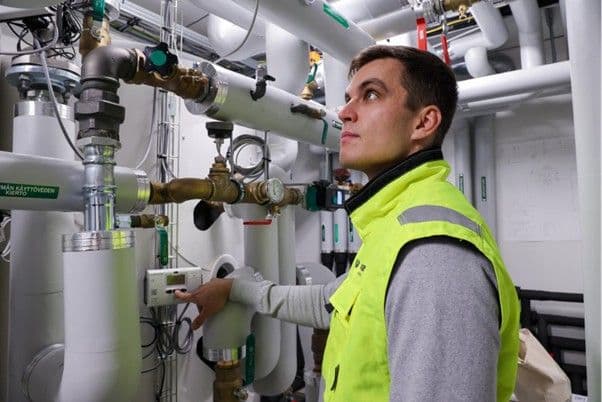
Efficiently operating energy systems with remote monitoring
Geothermal delivers sustainable, cost-efficient heat—provided it is continuously optimized through remote monitoring.
When the system is remotely controlled, the property simply works better
How does remote control create everyday value for property owners, prevent disruptions, and ensure optimal performance of a geothermal system year after year?
Geothermal energy is a sustainable and cost-efficient heating solution, but its true potential is realized only if the system operates correctly. After commissioning, the system is not “finished” – it requires continuous monitoring, optimization, and adaptation to changing conditions. Without professional remote control, systems may operate suboptimally for years, reducing energy efficiency and causing premature wear on equipment.
At Voltan, we have solved this through our service model. We take full responsibility for everything: design, technology, maintenance, and continuous remote control. The property owner only pays for the energy used and can focus on their core business – we take care of the rest.
Remote control is not just about reacting, but above all about anticipating. Emerging faults are often visible in collected data well in advance, allowing our control center to trigger alerts before issues escalate. Thanks to proactive monitoring, critical equipment failures are extremely rare. In addition, systems are designed with backup solutions to ensure heating continuity in case of failures.
Over Voltan’s history, emergency interventions have been minimal and can be counted on one hand. Most issues are resolved remotely or by the next business day in cooperation with contractors.
For the customer, the most important benefit is simple: peace of mind. They can trust that their property is continuously supplied with sustainably produced heat, optimized both for energy efficiency and system lifecycle.
Juha, how did you end up at Voltan?
I joined Voltan about 3.5 years ago, and it has been a natural continuation of my career. I graduated as an HVAC engineer in 2018 and as a Master of Science in Building Energy Technology in 2020. I have worked in the HVAC sector for nearly ten years in design and expert roles.
At Voltan, I have been able to combine my technical expertise with a broader context where I can truly influence how buildings are heated in a sustainable and efficient way.
In my role, I am responsible for the overall management of our plant portfolio. In practice, this includes remote monitoring of sites, optimization of technical performance, design of control systems for geothermal plants, coordination of maintenance, and collection of energy sales data for billing.
Currently, my time is roughly split between designing new systems and managing the existing portfolio.
What does a typical workday look like for you?
My work is divided roughly equally between designing new systems and managing and remotely controlling the existing portfolio.
A typical day starts in the control room, where I verify that all systems are operating as intended. If I detect suboptimal performance, I first adjust setpoints. If that does not resolve the issue, I begin diagnosing root causes more thoroughly. Deviations can stem from physical installations, equipment faults, or automation programming.
Recently commissioned systems require the most attention, as they need close monitoring during the early phase. Systems that have been in operation longer tend to run reliably with minimal intervention.
My work is also supported by Voltan’s experienced project managers and close collaboration with contractors.
Beyond monitoring, I continuously develop system control across the portfolio. For example, we have implemented control strategies based on spot electricity pricing and automated data collection into our data platform. These are concrete steps toward more intelligent energy management.
What is something people may not realize about geothermal systems?
When I joined Voltan, I quickly realized that the automation system is the “soul” of a well-functioning geothermal system.
The largest investments are made in heat pumps and borefields, while automation represents only a small portion of total CAPEX. However, poorly functioning automation can significantly impact lifecycle costs and may even undermine the investment’s profitability if not addressed in time.
This is an area where I see significant development potential going forward.
What makes your work meaningful, and why is remote control essential today?
I believe we make geothermal energy an accessible heating solution for our customers and a strong alternative to district heating. It is a highly functional and sustainable heating method, and it is rewarding to know that more properties are being heated cleanly and efficiently as a result of our work.
Today, energy systems are becoming increasingly complex, and that is precisely why the importance of remote control continues to grow. It is not an add-on service, but a prerequisite for ensuring optimal system performance over time.
Without remote control, even small issues can go unnoticed for years, reducing energy efficiency and causing premature equipment wear.
Remote control is what transforms geothermal from a piece of equipment into a service.